Eshan Jayamanne of Krane: Fixing the Gaps in Construction Procurement
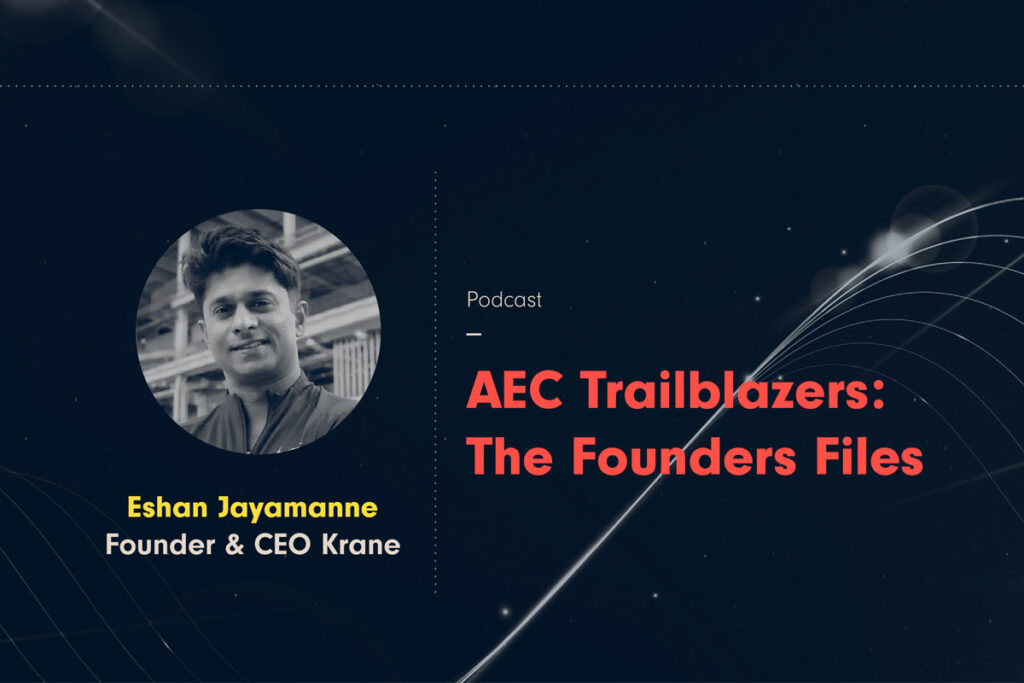
Eshan Jayamanne of Krane: Fixing the Gaps in Construction Procurement
Construction supply chains rarely fail because of one major mistake. More often, risk builds in the handoffs: between design and procurement, procurement and vendors, submittals and fabrication, delivery and installation, commissioning and owner turnover.
In this episode of AEC Trailblazers, Valentin Noves sits down with Eshan Jayamanne, Founder and CEO of Krane, to unpack why those handoffs are so difficult to manage and why traditional procurement software often struggles with the realities of construction.
Eshan’s perspective comes straight from the field. A third-generation builder and licensed Professional Engineer, he grew up around job sites before moving into civil and structural engineering. That experience exposed him to a recurring disconnect between the people designing projects and the teams responsible for building them, especially when information has to move from engineering decisions into field execution.
That gap became one of the central themes of the conversation.
Valentin and Eshan explore what makes construction supply chains fundamentally different from more standardized industries. Every project can introduce a different mix of equipment, vendors, specifications, compliance requirements, warranties, lead times, and custom materials.
For complex systems such as switchgear, generators, chillers, and air handling units, procurement begins long before equipment reaches the job site. Teams must evaluate availability, lead times, performance, compliance, warranties, and whether vendor bids actually meet project requirements.
Then come submittals, product data approvals, fabrication tracking, delivery, installation, commissioning, owner handoff, and ongoing operational information.
The material moves through one chain. The approvals and project data move through another.
Keeping those two aligned is where things get tricky.
Eshan explains why risk tends to accumulate between these stages and why so much critical information still lives across spreadsheets and disconnected systems. That fragmentation makes it harder to maintain visibility from specification through installation and identify problems early enough to protect the schedule.
The conversation also examines why off-the-shelf ERP and procurement platforms often fall short. Construction workflows are highly project-specific, spec-driven, and dependent on coordination across multiple stakeholders, making them difficult to fit into generic software models.
That is also the problem behind Krane. Drawing on experience across engineering, construction, and major-project material coordination, Eshan is building an AI-native approach to procurement and material management focused on earlier risk detection, better visibility, and a more predictable path from spec to install.
For anyone working in construction technology, procurement, engineering, or project delivery, this episode is a sharp look at the messy middle of how projects actually get built.
Listen to the full episode of AEC Trailblazers.
Host

Eshan Jayamanne
Founder & CEO
Originally from Sri Lanka, Eshan grew up in a construction family that spans three generations.
He was exposed early to how projects are built, how teams operate, and how much of the industry still depends on fragmented information, manual coordination, and avoidable inefficiency.
That firsthand perspective continues to shape the way he thinks about technology today.
At Krane, he leads a global team of engineers, designers, and operators working to improve how construction teams manage procurement and materials.
The company’s platform is designed to help owners, general contractors, and subcontractors gain earlier visibility into supply chain risk, with a strong emphasis on predictability, operational clarity, and schedule protection.
Eshan’s background combines deep project exposure with strong academic training.
He studied at Stanford Graduate School of Business and holds a master’s degree in Engineering Project Management from UC Berkeley.
That mix of field experience and strategic thinking gives him a particularly grounded point of view on what construction technology needs to do in order to be truly useful.
What makes his voice especially relevant in today’s AEC landscape is that he is not approaching AI as a layer of hype on top of construction.
He is building from a real operational problem.
His perspective sits at the intersection of engineering, supply chain execution, and AI-native software, with a clear focus on making construction more predictable, efficient, and resilient.

Valentin Noves
CEO at e-verse
A versatile leader with broad exposure to projects and procedures and an in-depth understanding of technology services and product development. He has a tremendous passion for working in teams driven to provide remarkable software development services that disrupt the status quo. He is a creative problem solver who is equally comfortable rolling up his sleeves or leading teams with a make-it-happen attitude.

Samuel Barcenas
BIM Consultant Founder of AVES
A highly motivated and experienced architect with a proven track record of success in designing and delivering innovative and sustainable buildings. He is also a BIM expert with a deep understanding of how to use technology to improve the efficiency and quality of the design and construction process.

Valentin Noves
I'm a versatile leader with broad exposure to projects and procedures and an in-depth understanding of technology services/product development. I have a tremendous passion for working in teams driven to provide remarkable software development services that disrupt the status quo. I am a creative problem solver who is equally comfortable rolling up my sleeves or leading teams with a make-it-happen attitude.